Loading...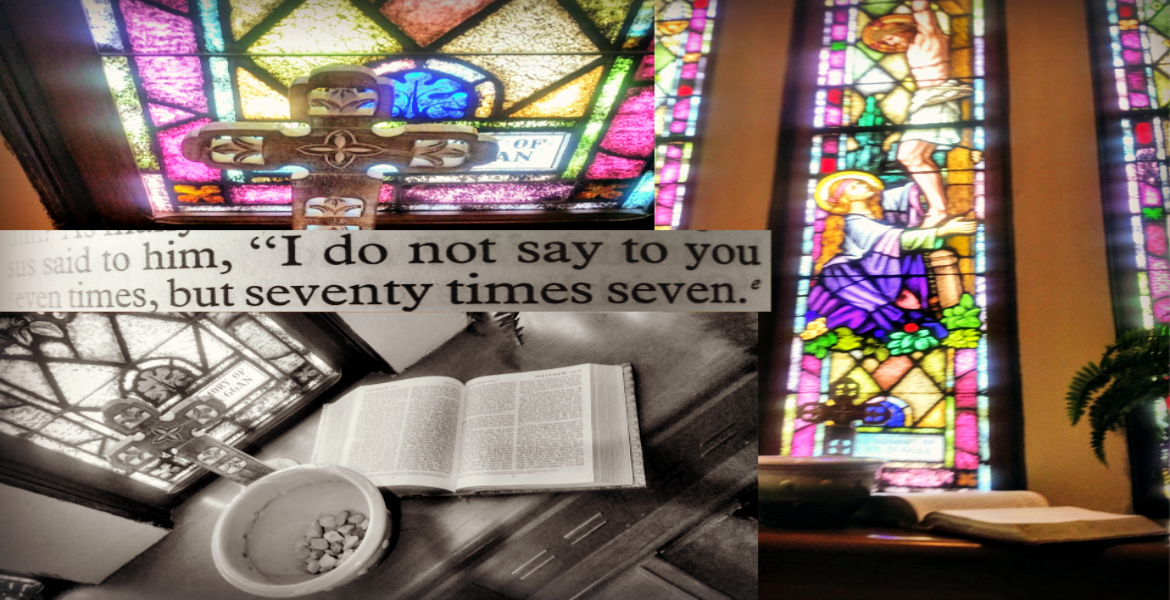
7 strikes and you're out. Peter sounds like a most charitable fellow. It is a lot more tolerant than the 3 strikes and you’re out standard he learned in Hebrew School. Jesus quickly responds, however, “Not 7 times but 70x7.” He’s not prescribing 490 strikes as the Jesus standard for forgiveness. He’s saying, “In your discipleship tool bag you’ll need a whole lot of forgiveness because in this life you’ll need every bit of it.” Soon the disciples, and the whole world, will witness the magnitude of Jesus’ forgiveness on a hill just outside the city walls of Jerusalem. For today, though, we are on the last leg of that northern journey,
far from Jerusalem, where Jesus has been laying the foundation of the church, his family of brothers and sisters. This family is being built with a lofty intention in mind, that it will be a model of the kingdom of heaven, that it will be an outpost of heaven, a little bit of heaven on earth, on a higher plane and a different level of reality, a family characterized by a conspicuous virtue - forgiveness.
The followers of Jesus are to be people who are forgiven and forgiving. To illustrate his point, Jesus tells a parable based on how things operate in an earthly kingdom, like the Roman Empire. There is, says, Jesus, a king, who calls in the accounts of his servants, who are likely officials the king has appointed to collect taxes from the provinces. The way the officials get these jobs, which can be lucrative, is by promising the king they can bring in the maximum amount of tax revenue, which is measured in talents, a measure of weight, one talent being somewhere between 60 and 75 pounds. Imagine a bag of gold weighing 1 talent. That’s a lot of loot. The Jewish historian Josephus tells about a certain year when 200 talents were collected from Samaria, 600 from Galilee, and 8,000 talents from Judea. That sheds a good bit of light on why Judea, a geographical backwater, was nevertheless of great value to Rome.
In accounting language, these promises become receivables, money counted on to fund the budget of the kingdom. Based on those promises, the king may have already taken up some important projects, like a wall in the north of Britain that is supposed to keep those ill-tempered Scotsmen in check.
One of the officials, Jesus says, owes the king 10,000 talents. Think 750,000 pounds of gold. That’s a lot of loot. He hasn’t made his quota. No wonder he’s not looking forward to this appointment. “Didn’t make your quota, I see,” says the king. “Off to the auction block you go, you and your family, to work off the debt.” There is no way the debt will ever be worked off. This is pure punishment. “Have mercy, I beg you. Give me some more time. I promise I’ll pay the full amount,” pleads the king’s servant. The king, we are told, is moved with pity, the same word that describes how Jesus felt when he saw the crowds following him along the shore of the Sea of Galilee, and he looked at them as sheep needing a shepherd. It’s a gut reaction that makes your insides churn. When I think about Jesus feeling this way about someone’s plight, it makes me think of a poem by William Blake,
Can I see another’s woe,
and not be in sorrow too?
Can I see another’s grief,
and not seek for kind relief?
Can I see a falling tear,
and not feel my sorrow’s share?
Moved with pity, the king takes extraordinary action. Instead of granting the extension of time, he cancels the debt entirely. We’ll just have to figure out another way to pay for that Scottish border wall.
Released from such an obligation, the king’s servant leaves the palace with a lightness in his step, but a heavy burden on his heart, the burden of mercilessness, which dictates how he treats a fellow servant who owes him 100 denarii, about three months’ wages for an average worker in that time. For reference, it takes 6,000 denarii to make a talent, so this guy is grabbing at the throat of another guy who owes him 1/600,00th of the debt from which, in an act of pure grace, he has just been released. No wonder that when the king finds out what has happened, that the servant whose desperate plight made his guts churn, to the point that he cancelled a colossal debt, no strings attached, has sent another servant and his family to the torturers, the jailers whose job is to make your life hell on earth, over an amount that is a trifle in comparison, he calls the servant back to his chambers, castigates him as a wicked man, uncancels the debt, and then sends him to the torturers until it is paid in full, which it will never be.
No Peter, don’t stop at 7. If you hope for a place in the Father’s house, let forgiveness flow like a never ending stream.
After supper he took the cup of wine;
and when he had given thanks,
he gave it to them, and said,
“Drink this all of you:
This is my Blood of the new Covenant,
which is shed for you and for many
for the forgiveness of sins.”
Such a price paid for our forgiveness.Who can be so forgiven and dare forgiveness withhold?